
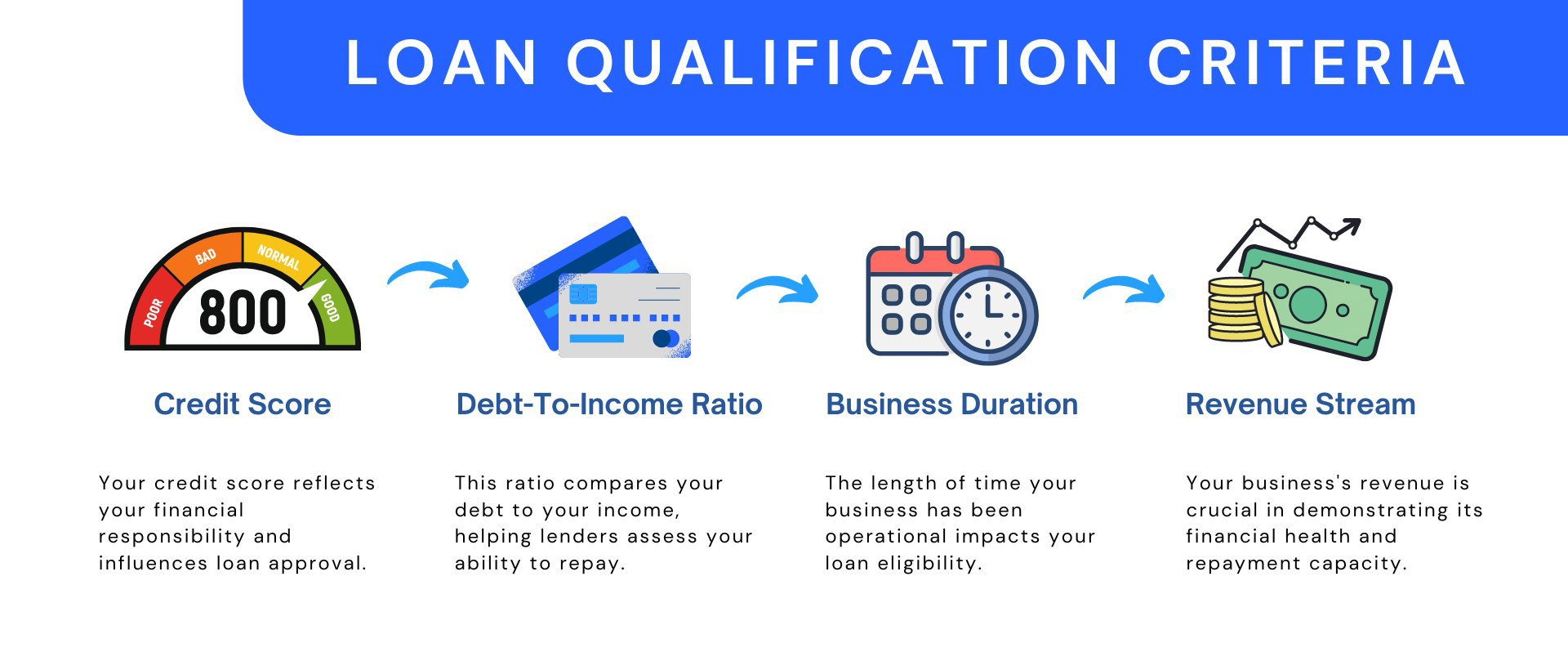
Taking on business debt is a significant financial decision. Borrow too early and monthly payments strain cash flow before the business is ready. Wait too long and you miss the growth window that financing was supposed to support.
Before you apply, run through this self-assessment to see where your business stands, what lenders will evaluate, and what to strengthen before approaching them.
The 5 Things Lenders Evaluate
Every lender, from banks to online lenders to MCA providers, looks at some version of these five factors. The weight each one carries depends on the loan product and the lender.
1. Credit Score (Personal and Business)
For small businesses, lenders almost always check the owner's personal credit score. Your business credit score (Dun & Bradstreet, Experian Business) matters too, but personal credit carries more weight for loans under $500,000.
| Credit Score Range | Options Available | |-------------------|-------------------| | 720+ | SBA loans, bank term loans, best rates on everything | | 680-719 | Most online lenders, equipment financing, LOCs, some SBA | | 620-679 | Online term loans, equipment financing, invoice factoring | | 580-619 | Select online lenders, MCAs, factoring | | Below 580 | MCAs, revenue-based financing, factoring only |
If your score is below where you want it, check for errors on your credit report. Disputing incorrect information can improve your score within 30 days. Paying down credit card balances below 30% of the limit is the next fastest improvement.
2. Time in Business
Lenders use time in business as a measure of stability. A business that's survived 2+ years has demonstrated staying power.
| Time in Business | What's Available | |-----------------|-----------------| | Under 6 months | Very limited: some MCAs, personal loans, friends and family | | 6-12 months | Online lenders, factoring, MCAs, some equipment financing | | 1-2 years | Most online lenders, equipment financing, some banks | | 2+ years | Full range of options including SBA and bank loans |
Starting the loan process right before you cross a threshold (like applying at 11 months instead of waiting for 12) can mean the difference between denial and approval.
3. Revenue and Cash Flow
Revenue proves your business generates money. Cash flow proves there's money left after expenses. Lenders care about both, but cash flow matters more.
A business with $500,000 in revenue and $490,000 in expenses is in a weaker position than a business with $200,000 in revenue and $120,000 in expenses. The first business has a thin $10,000 margin. The second has $80,000 to work with.
Minimum revenue thresholds by lender type:
- Online lenders: $10,000-$15,000/month
- Banks: $20,000+/month
- SBA lenders: varies, but consistent revenue history matters more than amount
Check your debt service coverage ratio with our DSCR calculator to see how lenders measure your repayment capacity.
4. Existing Debt
Lenders look at your total debt picture. High existing payments reduce how much new debt you can take on and push your DSCR lower.
Questions lenders ask:
- What are your current monthly loan payments?
- What's the total outstanding balance across all debts?
- Are all current loans in good standing?
- Do any existing loans have UCC liens that would conflict?
If your total monthly debt payments already consume most of your free cash flow, adding more debt may not be possible until you reduce what's outstanding.
5. Documentation Readiness
Missing or outdated documents are one of the top reasons applications stall or get denied. Having everything current and organized before you apply sends a strong signal to lenders.
Check these before applying:
- Tax returns filed and current (personal and business, last 2-3 years)
- Bank statements accessible (last 3-6 months)
- Profit and loss statement up to date
- Balance sheet current
- Business registration and licenses valid
Use our loan document checklist to see exactly what you'll need for your specific loan type.
Quick Readiness Scorecard
Answer these 8 questions honestly to gauge where you stand:
| Question | Yes | No | |----------|-----|-----| | Is your personal credit score above 650? | +2 | +0 | | Has your business been operating for 1+ years? | +2 | +0 | | Is your monthly revenue above $15,000? | +2 | +0 | | Are you profitable (revenue exceeds all expenses)? | +1 | +0 | | Are all existing loans current with no missed payments? | +1 | +0 | | Do you have 3+ months of bank statements ready? | +1 | +0 | | Do you have a clear purpose for the loan funds? | +1 | +0 | | Is your DSCR above 1.25? | +2 | +0 |
How to read your score:
| Score | Assessment | |-------|------------| | 10-12 | Strong candidate. You should qualify for competitive rates from multiple lender types. | | 7-9 | Good position. You'll qualify for most online lenders and some bank products. Minor improvements could unlock better rates. | | 4-6 | Needs work. Focus on the areas where you scored 0 before applying. You may qualify for online lenders, MCAs, or factoring. | | Under 4 | Wait and build. Spend 60-90 days improving your weakest areas before submitting applications. |
Get a more detailed score and personalized improvement plan with our funding readiness assessment.
What to Do If You're Not Ready Yet
If your scorecard came back lower than you'd like, these improvements make the biggest impact in the shortest time.
Improve Your Credit (30-60 days)
- Dispute errors on your credit report. Incorrect collections, wrong balances, and outdated accounts can be removed within 30 days.
- Pay down revolving debt. Reducing credit card balances below 30% of your limits can improve your score by 20-40 points within one billing cycle.
- Become an authorized user on a family member's credit card with a long history and low utilization. This adds positive history to your report.
- Don't open new accounts in the 60 days before applying. New accounts lower your average account age and create hard inquiries.
Build Revenue History (30-90 days)
- Wait for the threshold. If you're at 5 months of business history, waiting until month 6 or 12 opens up significantly more options.
- Maintain consistent deposits. Lenders look at deposit consistency, not just total amounts. $15,000 deposited every month looks better than $5,000 some months and $40,000 others.
- Separate business and personal finances. If you're still running business revenue through a personal account, open a business account now. Lenders want to see dedicated business banking.
Organize Your Finances (1-2 weeks)
- Get bookkeeping current. If you're behind on categorizing expenses, spend a weekend in QuickBooks or hire a bookkeeper for a one-time cleanup.
- Prepare a simple P&L. Even a spreadsheet showing monthly revenue and expenses for the past 12 months helps.
- Gather supporting documents. Contracts, customer lists, and purchase orders add context that can overcome marginal financials.
Reduce Existing Debt (30-90 days)
- Pay off small balances. Eliminating a $5,000 credit card balance or a $200/month loan payment directly improves your DSCR.
- Avoid taking on new debt (especially MCAs or high-interest products) in the months before applying.
- Consolidate if it helps. If you have multiple small debts, consolidating into one payment at a lower rate improves your profile and simplifies your debt schedule.
What to Do If You Are Ready
If your scorecard puts you at 7+ and your documents are in order, here's how to approach the process.
Know your purpose. Lenders ask "What is this loan for?" Have a clear, specific answer. "To purchase $60,000 in inventory for Q4 holiday season" is strong. "General business needs" is weak.
Know your numbers. Before speaking with any lender, know: how much you need, what you can afford monthly, your credit score, your annual revenue, and your DSCR. Being prepared makes you a more credible borrower.
Compare 2-3 options. Don't take the first offer you get. Different lenders offer different rates, terms, and structures. Use our business loan comparison tool to evaluate offers side by side.
Time your application. Apply when your financials are strongest: after a strong revenue quarter, when bank balances are healthy, and when all documents are current. Don't apply during your slowest month.
See your options with no impact to your credit score.
Frequently Asked Questions
What credit score do I need for a business loan?
It depends on the loan type. SBA and bank loans typically require 680+. Online term loans generally need 580-620+. Equipment financing starts around 550-600. MCAs and factoring may approve scores as low as 500. The higher your score, the lower your interest rate and the more options you have.
How long does my business need to be open to get a loan?
Most online lenders require 6-12 months of operating history. Banks and SBA lenders prefer 2+ years. Some MCAs approve businesses as young as 4 months. Invoice factoring has minimal time requirements since it's based on your customers' creditworthiness, not your business age.
How much revenue do I need for a business loan?
Most lenders look for at least $10,000-$15,000 in monthly revenue. Banks and SBA lenders often require higher amounts ($20,000+/month). Revenue-based lenders and MCAs may approve with lower revenue if it's consistent. The key metric isn't just revenue but the ratio of revenue to expenses (cash flow).
Can I get a business loan with no collateral?
Yes. Many loan products are unsecured: online term loans, business lines of credit, MCAs, and invoice factoring don't require traditional collateral. However, most unsecured lenders do require a personal guarantee, which means the owner is personally liable for repayment. Unsecured loans typically carry higher interest rates than secured products. Learn more about no-collateral options.
When is the right time to take on business debt?
When you have a specific, funded purpose with a clear return on investment. Good reasons: equipment that increases production capacity, inventory for a confirmed large order, bridging a seasonal cash flow gap with predictable recovery. Bad reasons: covering operating losses with no plan to become profitable, speculative expansion without market validation, or paying off personal expenses through the business.
Take the guesswork out. Complete our funding readiness assessment in 2 minutes.